Stress Happens Underground Before It Appears Above Ground
By the time you can see moisture stress in a crop — wilted leaves in the morning heat, a dull grey-green colour, leaf rolling in cereals — the plant has already been in deficit for some time. Visible stress symptoms are the crop telling you it has passed the point where it can easily recover. The soil moisture chart, if you know how to read it, tells you about stress days or even weeks before it becomes visible.
This early warning is the biggest practical advantage of soil moisture monitoring for crop management. Catching a deficit before it becomes visible stress gives you options: adjusting irrigation scheduling, prioritising paddocks with the most limited water, or at minimum knowing which crops are heading into a critical growth stage with a depleted profile. Reacting to visible stress is always more expensive than preventing it.
The Refill Point: Where Stress Begins
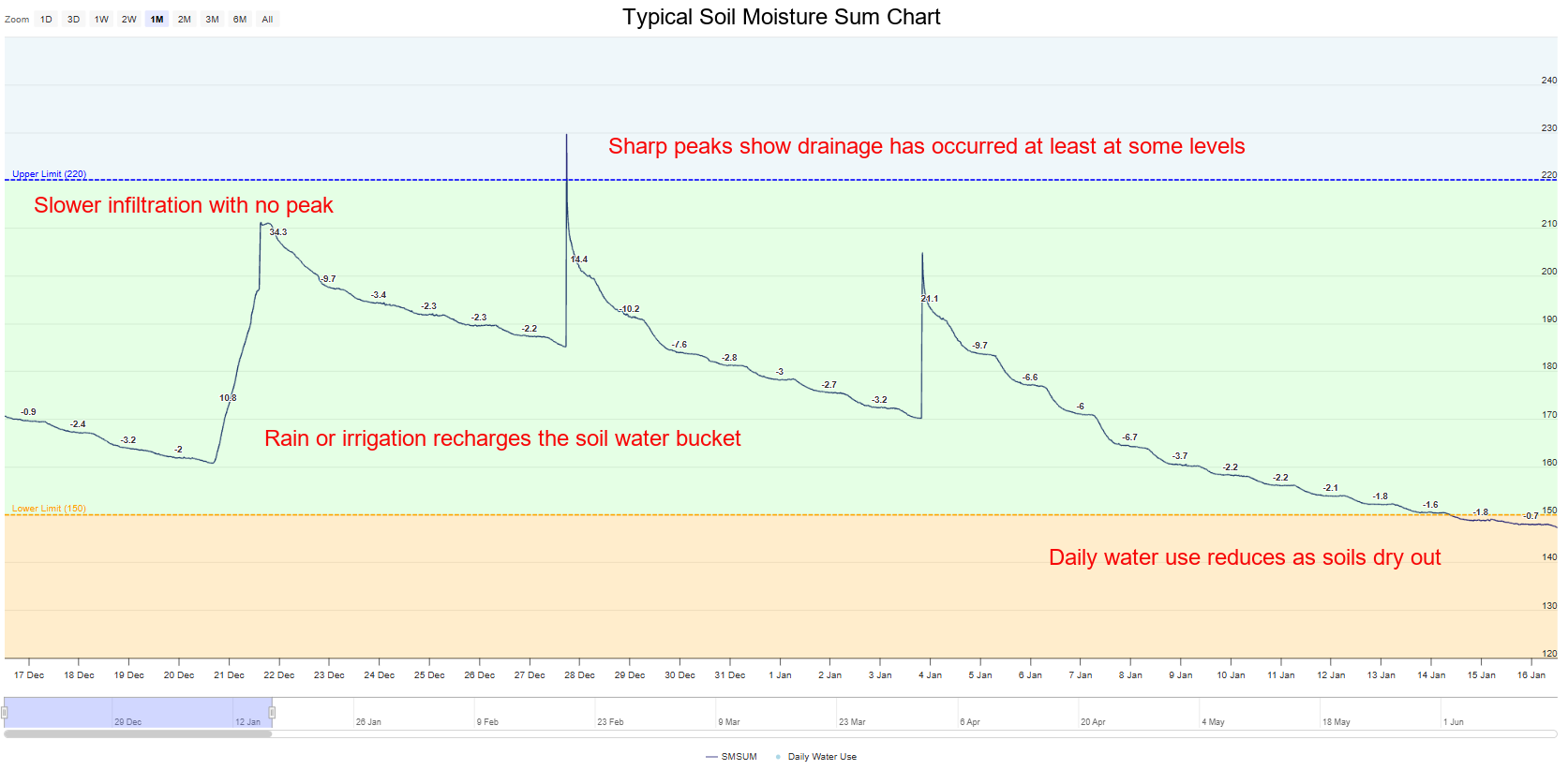
Most soil moisture platforms define two key reference lines in your chart: field capacity (the upper limit, where the soil is full) and the refill point or lower limit (the threshold below which crop water use efficiency starts to decline and stress begins). The refill point is not the permanent wilting point — it is not where the plant dies. It is the point at which the plant has to start working significantly harder to extract water from the soil, and where that extra work starts taking resources away from growth and grain fill.
When your soil moisture chart shows readings falling through the refill point and heading toward the lower limit, your crop is beginning to experience stress. The severity of the stress depends on how far below the refill point the chart has moved, which growth stage the crop is in, and what the temperature and evapotranspiration demand is at the time.
In practical terms: a chart showing all sensors sitting above the refill point is a crop with adequate water. A chart showing the top sensors below the refill point but the deeper sensors still above it indicates moderate stress developing in the upper root zone while deeper roots still have supply. A chart showing all sensors below the refill point and approaching the lower limit is a crop under significant stress that needs intervention if one is available.
The Extraction Curve: Watching the Profile Drain From the Top
One of the most useful stress indicators is watching the sequence in which soil moisture depletes through the profile. In a healthy, unstressed crop with a well-developed root system, you would expect to see relatively even drawdown across all sensor depths as the roots extract water from the whole profile. When a crop begins to run out of water in the upper profile, you will see a distinctive pattern: the top sensors flatten out because there is nothing left to extract there, while the deeper sensors continue to decline as the roots pull from deeper reserves.
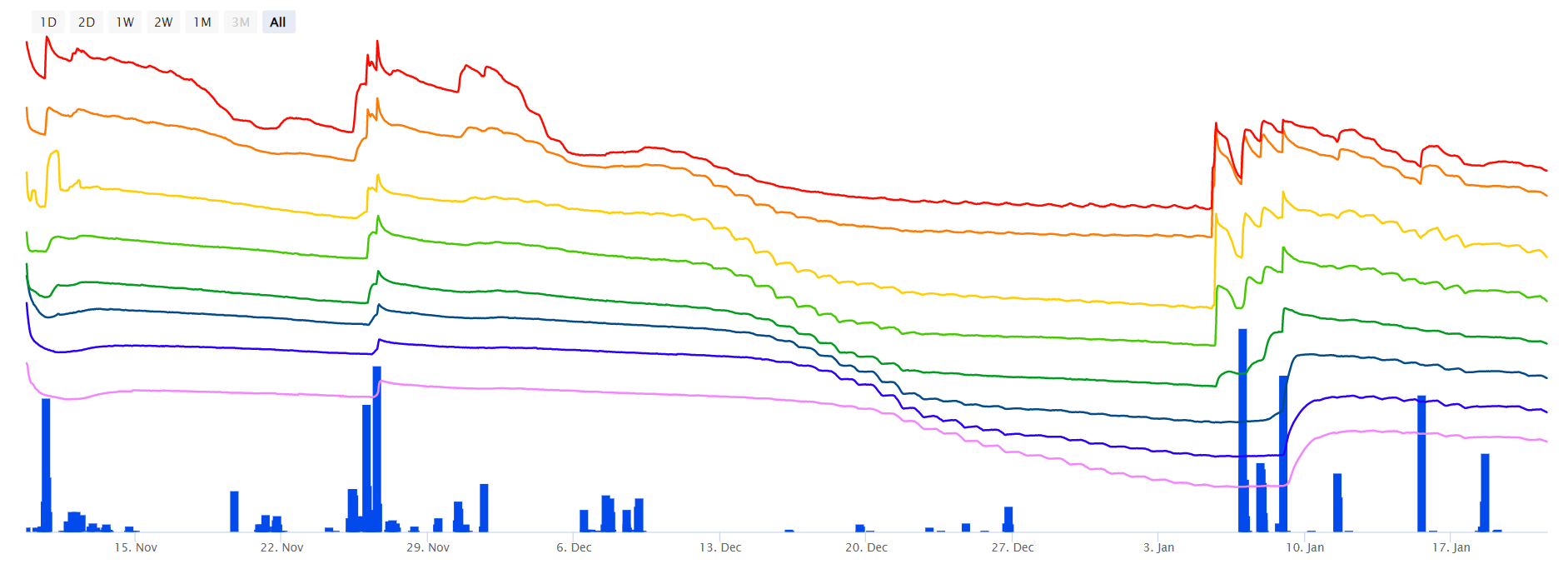
This downward progression of the extraction front tells you the crop is actively chasing moisture deeper into the profile. It is not necessarily a crisis — deep roots are part of normal crop function — but it signals that the upper profile is depleted and the crop is dependent on what is below. If those deeper sensors are also running down rapidly with no rainfall in the forecast, you are watching a stress event developing in real time.
A stressed crop will also show a change in the daily drawdown rate. As moisture stress sets in, the stomata partially close to reduce water loss through transpiration. This actually shows up on the chart as a slight reduction in the rate of daily drawdown compared to unstressed conditions — the crop is protecting itself, but at a cost to photosynthesis and therefore yield.
Stress at Different Growth Stages: When It Hurts Most
Not all growth stages respond equally to moisture stress. Understanding which stages your crop is most vulnerable at helps you interpret what the chart is telling you in the right context.
For wheat, the most yield-sensitive period for moisture stress is from flag leaf to early grain fill — roughly from mid-spring to early summer in southern Australia. Stress during this period directly reduces potential grain size and therefore final yield. Stress at the same severity during tillering is a concern but the plant has more capacity to compensate if conditions improve later.
For canola, the flowering period is extremely stress-sensitive. Water deficit during flowering causes pod abortion and directly reduces pod numbers, which is one of the major determinants of canola yield. A soil moisture chart showing values dropping below the refill point during a canola flowering period should be taken seriously even if the stress is not yet visible in the crop.
For irrigated summer crops — corn, sorghum, cotton — the most critical period is typically from tassel emergence through to early grain fill, when the crop is at its highest daily water demand and the consequences of a deficit are most severe.
Temporary Versus Permanent Wilting: The Key Distinction
Temporary wilting occurs when the atmospheric demand for water — driven by heat and low humidity — temporarily exceeds the rate at which the plant can extract and move water, even when there is adequate moisture in the soil. On a hot, windy afternoon with Delta T above 10, you will see crops wilting in the paddock even over soil that has moisture above the refill point. The plant recovers overnight as temperatures drop and the demand reduces. This is not a sign of soil moisture stress — it is a sign of normal crop physiological response to extreme atmospheric conditions.
Permanent wilting occurs when the soil moisture is genuinely depleted to the point where the plant cannot extract enough water to maintain turgor regardless of atmospheric conditions. A plant that is wilted in the morning and does not recover is under genuine stress. On the soil moisture chart, permanent wilting conditions correspond to readings approaching or below the lower limit across the root zone.
The chart lets you distinguish between these two scenarios without walking the paddock at different times of day. If the soil moisture is above the refill point and you see wilting in the paddock, it is atmospheric demand driving it. If the chart shows values below the refill point, the wilting you are seeing is a genuine soil moisture problem.
Using the Chart to Time Your Irrigation Response
The most direct action that flows from identifying moisture stress on a chart is adjusting your irrigation schedule to intervene before the refill point is crossed rather than after. This is more efficient than irrigation in response to visible stress because the plant has not yet been compromised, your water application refills a depleted but not exhausted profile, and you are applying water when the crop is best positioned to use it.
In dryland systems where irrigation is not an option, soil moisture stress monitoring still has value: it tells you which paddocks are in the most critical state, which crops are most likely to benefit from rainfall when it does come, and where the seasonal risk is concentrated. That information feeds into management decisions about nutrient applications, spraying programs, and harvest timing that are all relevant to the final outcome.
BushLinx® soil moisture monitoring gives you the full profile picture — top to bottom, updated continuously — so you can see moisture stress developing before it costs you yield. The platform shows your readings against your refill point and field capacity reference lines so the interpretation is straightforward, and you can set alerts to notify you when any depth drops below the threshold so you are not relying on remembering to check.
See stress before it costs you yield
BushLinx® soil moisture probes update continuously and display readings against your refill point and field capacity lines — so you catch a developing deficit before it becomes visible in the crop.
See Soil Moisture Probes → Talk to Tim