What You Are Actually Looking At
A soil moisture chart looks like a simple graph — time along the bottom, moisture percentage up the side. But what it is really showing you is a live portrait of what is happening underground in your paddock. It tells you how much water is sitting in your soil at each depth, whether it is going up or down, and whether your crop has what it needs to get through the next few days.
Most soil moisture probes used in Australian agriculture are capacitance probes measuring volumetric water content — essentially, how much of the soil pore space is filled with water at any given moment. The numbers are usually expressed as a percentage (%) or millimetres (mm). The specific numbers a capacitance probe gives is not the most important thing, these will vary a fair bit with what soil type the probes are installed in. Heavy clays show higher numbers while sandy soils show lower numbers. The most important thing is the change in the numbers and the shape of the lines this change makes. This is what tells you what is happening to plant available water through the root zone. To make the job of using the data in practical decisions easy, there are 2 levels of soil moisture to identify as quickly as possible. Firstly the full point, sometimes referred to as field capacity or drained upper limit. The second is the refill point or sometimes referred to as the crop lower limit or driest ever level depending on what you are using your soil moisture probe for - irrigation or cropping.
Everything that matters for your management decisions sits in the range between those two points. Understanding that range is the whole game.
The Two Reference Lines That Change Everything
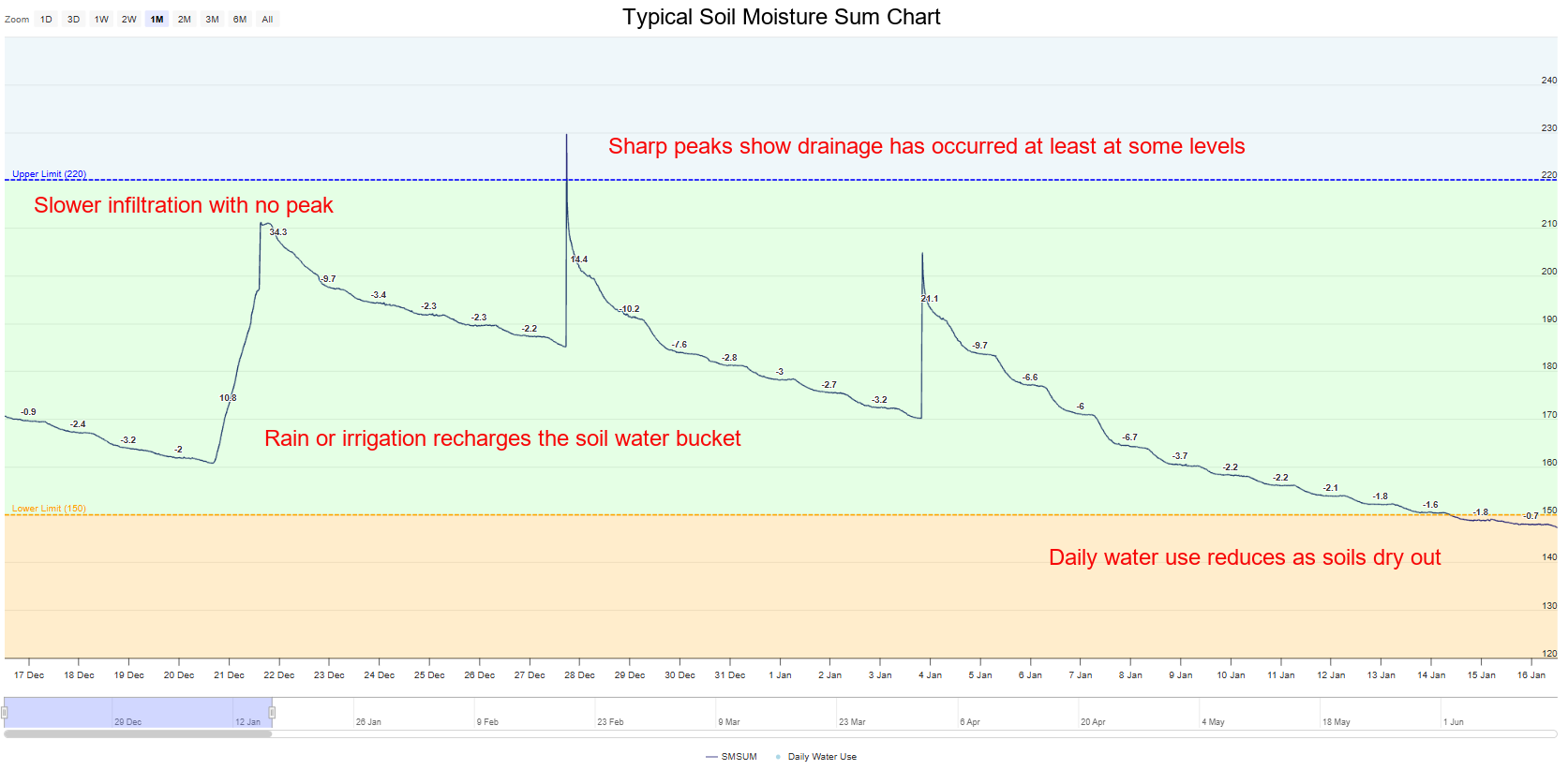
The two most important lines on any soil moisture chart are field capacity and the refill point. If your software or platform shows them, learn where they sit before you look at anything else.
Field capacity is the upper limit — the amount of water the soil holds after free drainage has stopped following a good rain or irrigation. When your soil is sitting at field capacity, it is full. The roots have all the water they need, there is no more room for irrigation without pushing water past the root zone, and oxygen is just starting to return to the soil pores. A good rain event will push soil moisture right up to this line and the chart will show a sharp upward spike.
The refill point — sometimes called the lower limit or the trigger point — is the threshold below which you want to intervene. It is not the point at which the plant is dead or even severely stressed. It is the point at which you should act, because if you wait much longer the plant will start working harder to extract water and growth will slow. Where that line sits depends on soil type, crop, and growth stage, but a common rule of thumb for irrigated systems is around 50 per cent of plant-available water consumed.
The gap between field capacity and refill point is your working range. How fast the chart moves through that range tells you a lot about what your crop is doing and what the weather is throwing at it.
Reading the Shape of the Lines
A healthy soil moisture chart during a growing season has a recognisable rhythm. After a rain event or irrigation, you will see a sharp rise toward field capacity at each sensor depth. Then, as the crop uses water and the soil drains, the lines fall gradually and steadily. How steep that fall is will vary with temperature, crop growth stage, and root depth.
In a multi-depth probe, a key thing to watch is which depths are moving first. Your top sensors — say the 10 centimetre and 20 centimetre depths — will respond to rain almost immediately. Your deeper sensors at 60, 80, or 100 centimetres will only move if the rain was significant enough to push water all the way down. If you see your top sensors jump after a rain event but your deeper sensors stay flat, you know the rain only wet the surface and the crop is still drawing on deeper reserves, or the deeper levels are already at field capacity or saturated. Saturated soils at depth usually shows up as very constant values, whilst drier soil do show values changing slightly.
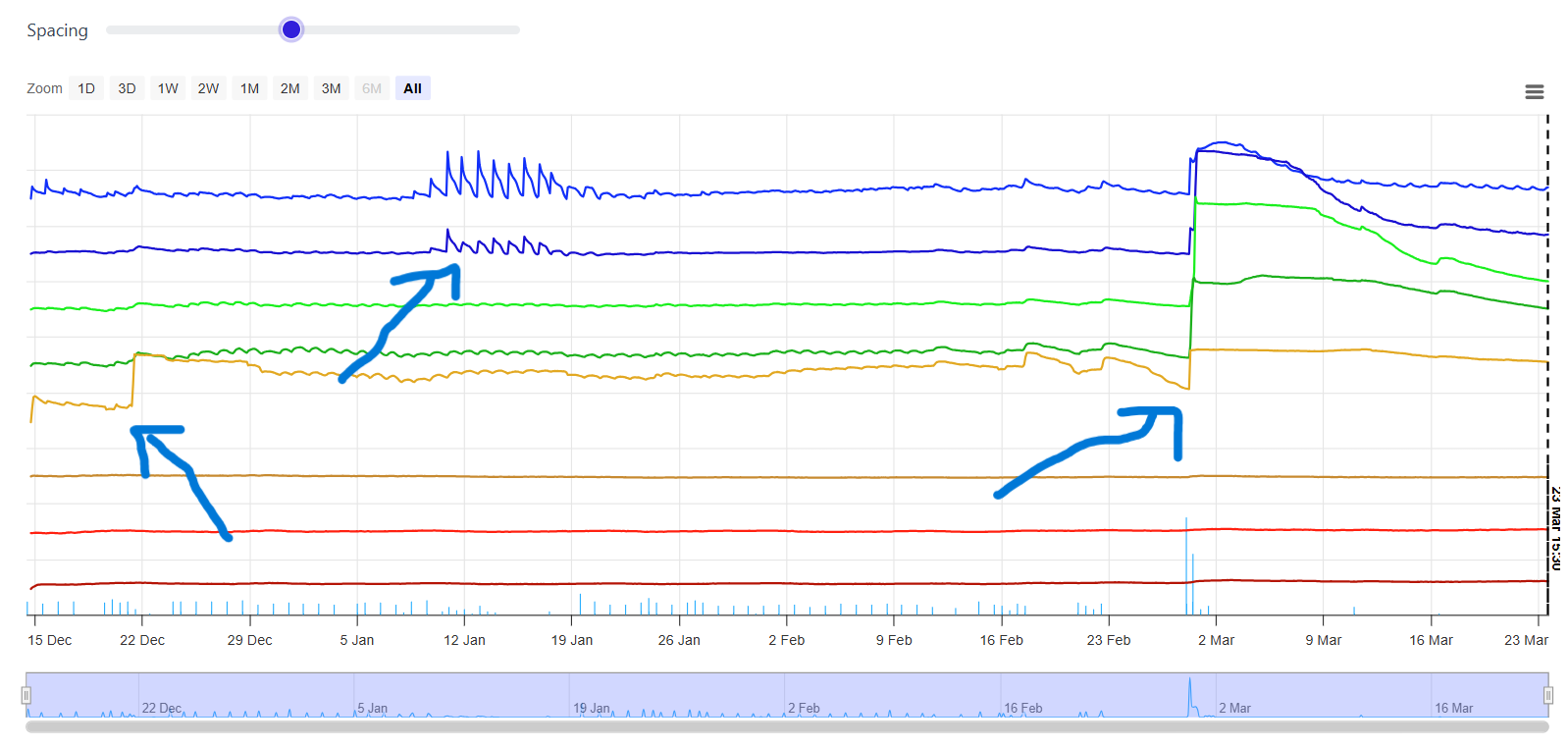
That is one of the most valuable things a soil moisture chart tells you — whether that 20 millimetres that fell last Tuesday actually did anything meaningful for your subsoil, or whether it just sat in the top few centimetres and evaporated.
What Normal Looks Like Through the Season
Early in the season, before canopy closure, your soil moisture will drain relatively slowly because the crop leaf area is small and not using much water. As the crop grows and the canopy closes, you will see the daily drawdown rate increase quite noticeably. A wheat crop at flag leaf in warm conditions can pull five to eight millimetres out of the soil per day. A corn crop in grain fill can pull even more.
This seasonal acceleration in water use is one of the clearest signals on a soil moisture chart. If you have been watching your chart all season and you suddenly notice the lines are dropping noticeably faster than they were three weeks ago, your crop is entering a critical growth stage and your water management decisions just got more important.
Common Misreadings to Avoid
One of the most common mistakes is seeing a small rise in soil moisture after light rain and assuming the crop has been recharged. If 8 millimetres falls on a day when the soil surface is very dry, the rain may not even reach your shallowest sensor depending on where it is installed. The surface appears wet and the paddock looks refreshed, but the chart tells the real story.
Another common misreading is assuming a flatline is good news. If your soil moisture sits at the same level for days without going up or down, it could mean the sensor is faulty, the soil at that depth is hydrophobic, or there has been zero drainage and zero crop uptake at that layer. A genuine flatline in the middle of a dry spell, at a depth where roots should be active, usually warrants investigation rather than celebration.
Making Decisions From the Data, Not Just Looking at It
Reading a chart is only useful if it changes what you do. The three decisions a soil moisture chart should drive are: when to irrigate, how much to apply, and whether a rain event has recharged the profile enough to hold off. Every time you look at your chart, ask yourself those three questions. If the answer is not clear, look at where you are relative to your refill point and field capacity lines, and the decision usually becomes obvious.
The BushLinx® platform displays your soil moisture data alongside rainfall and temperature readings from your on-farm weather station so you can see cause and effect on the same screen. Seeing a 15 millimetre rain event on the same chart as your soil moisture response — or lack of response — makes the data immediately actionable rather than just interesting.
Interested in soil moisture monitoring?
BushLinx® EnviroPro probes measure volumetric water content at multiple depths, displayed live alongside your weather station data.
See Soil Moisture Probes → Talk to Tim