The Surface Deception
This is one of the most common and costly mistakes in irrigated agriculture in Australia: irrigating until the surface looks and feels wet, then assuming the job is done. The soil surface is the most visible part of the paddock and the easiest to assess by walking through or observing colour change. But a plant does not feed from the surface. Its roots are deeper, and whether those roots have access to water is a completely different question to whether the top 10 centimetres is moist.
Irrigators who move from managing by feel and observation to managing with a soil moisture probe almost universally report the same initial surprise: they discover they have been either under-irrigating (wet surface, dry subsoil) or over-irrigating (water pushed well past the root zone, contributing to waterlogging, drainage, and in some cases leaching of nutrients). Both situations have real economic costs.
What Root Zone Penetration Looks Like on a Chart
When you run an irrigation event and watch a multi-depth soil moisture probe, you will see the soil moisture rise at each sensor depth in sequence, from the top down. The 10 centimetre sensor responds almost immediately. The 20 centimetre sensor follows. Whether the 40, 60, and 80 centimetre sensors respond — and by how much — is the answer to whether your irrigation is reaching the full root zone.
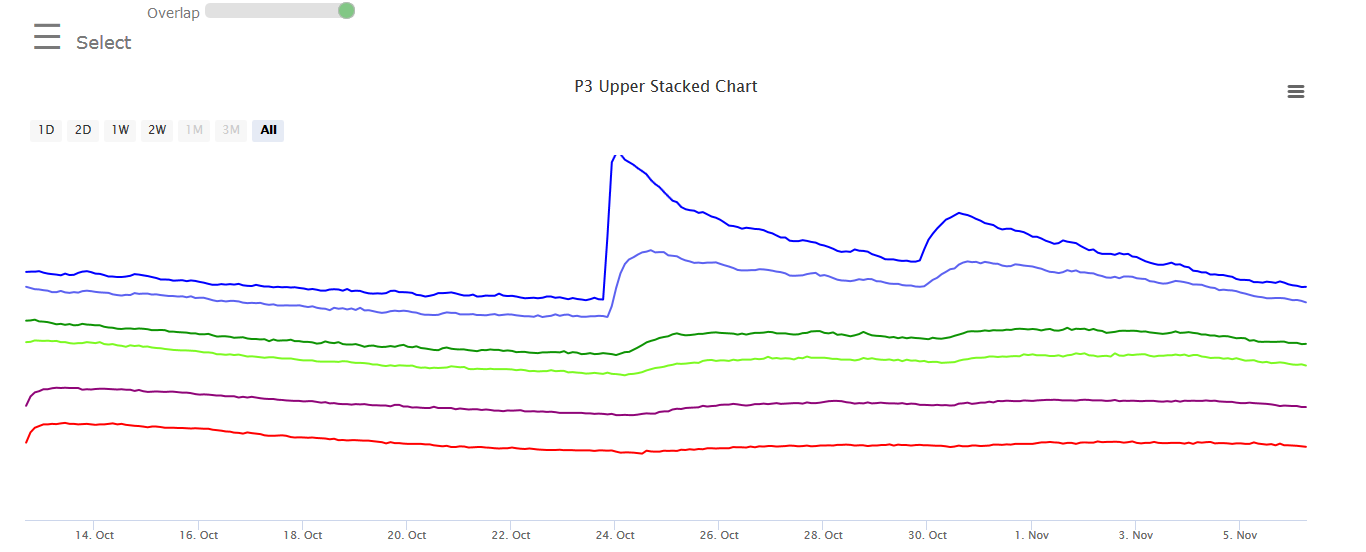
A well-managed irrigation event on a crop with a developed root system should produce a visible response across all sensors in the active root zone. If you are irrigating a pasture with roots down to 40 centimetres, you should see clear movement at all sensors down to that depth. If you are running a summer crop with roots at 80 centimetres, you want to see movement down there too — not the same intensity as the surface, but a definite response.
If your irrigation event produces a sharp peak in your top sensors and nothing below 20 centimetres, one of three things is happening: the irrigation event was too short to push water that deep, you have a soil profile that restricts downward movement (a clay layer, a compaction layer, or hydrophobic organic matter), or your roots have not yet developed to that depth in a young crop.
Over-Irrigation: What It Looks Like
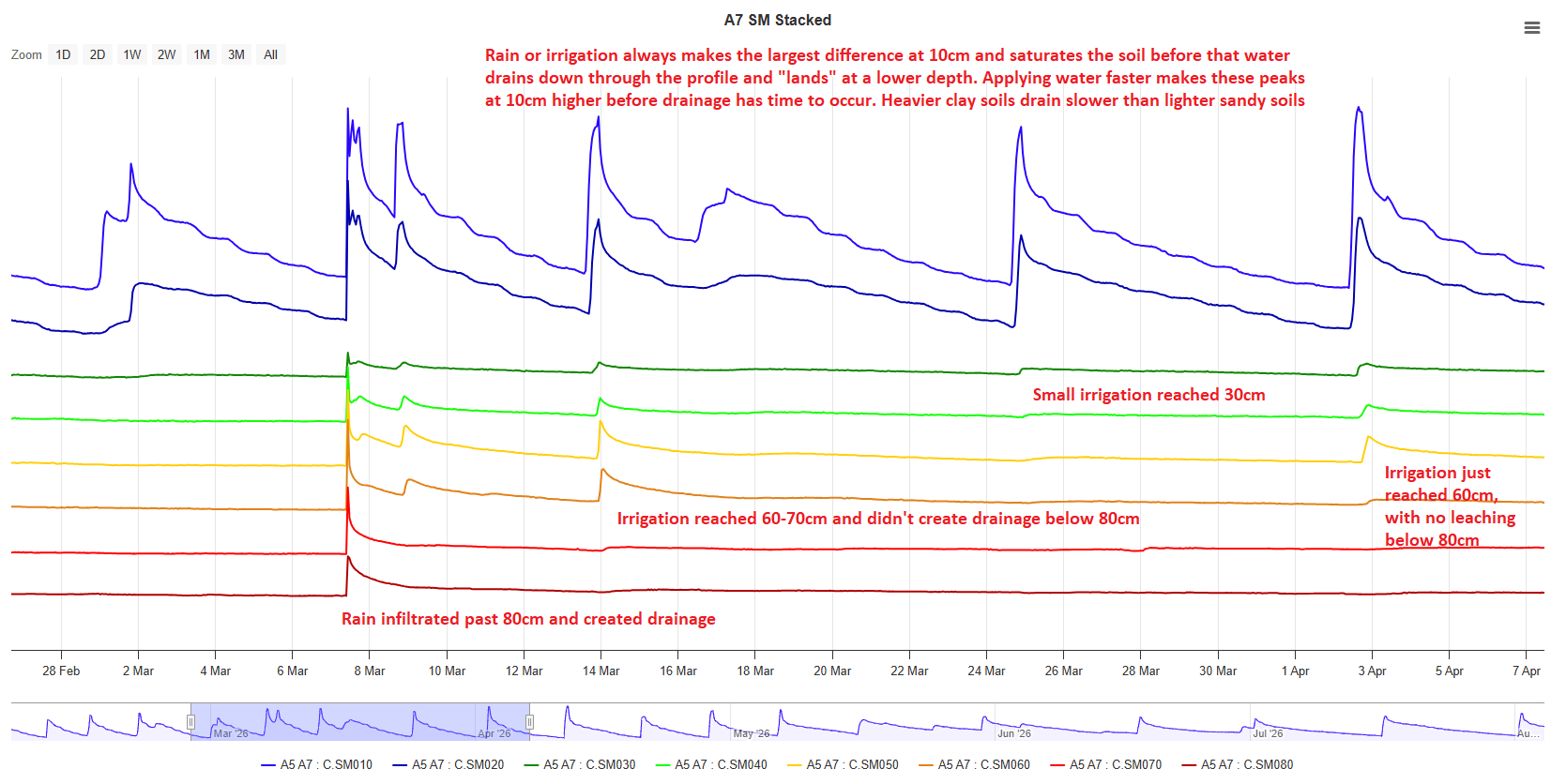
Over-irrigation is easier to identify on a soil moisture chart than people expect. When you push more water into the soil than the root zone can hold, the moisture at your shallow sensors will climb to or past field capacity. In some soil types this is obvious because the sensor reading maxes out and stays there. In other soil types, the excess water moves through quickly and you see the deep sensor — below the root zone — start to rise, which tells you water is draining past the roots entirely.
Free drainage past the root zone is not just wasteful. In intensive horticultural and perennial systems it takes nutrients with it. In some high-clay or low-permeability soils it creates waterlogging conditions that reduce oxygen availability in the root zone and can set back plant growth more than a dry period would have.
The irrigation scheduling goal should be to fill the root zone to field capacity with minimal drainage below it. The stacked soil moisture chart lets you watch what happens every 10cm depth through the soil profile each time you irrigate and adjust your irrigation amount and timing to achieve high efficiency irrigation practices.
Under-Irrigation: The Sneaky Problem
Under-irrigation is trickier because the surface still gets wet and the paddock still looks like it has been watered. But if your chart shows that your deep sensors (the deeper root zone) have not moved in several irrigation events, your crop is only able to get the water it needs from the top shallower depths. This is known as a shortened or restricted root zone and reduces a crops ability to cope with hot days and periods of high water demand. It's the old surface area problem, less roots in a smaller volume of soil can access less water than lots of roots in a larger (deeper) volume of soil. So having a healthy size (depth) root aone allows the crop to cope with high water demands better than a shortened shallow root zone.
Deep roots are more than just an insurance policy against dry spells. They are active contributors to nutrient uptake, particularly for mobile nutrients like nitrogen. A crop that is stressed at depth because its deep roots are running dry is performing below its potential even if the surface conditions look fine. You will not necessarily see visible stress symptoms in the crop until the situation is quite advanced.
Adjusting Your Irrigation Strategy
Once you can see what your irrigation is actually doing across the full profile, the adjustments are usually straightforward. If you are consistently failing to reach the bottom of the root zone, you need either larger or more frequent irrigation events, depending on your system and soil. If you are consistently pushing past the root zone, you need shorter smaller events, possibly split over more frequent applications.
In furrow and flood irrigation systems, the shape of the wetting front can also tell you about uniformity — whether the head end of your bay is getting more water than the tail, for example, or whether certain paddock areas have different infiltration rates that are creating dry spots or contributing to the run time for particular bays.
BushLinx® soil moisture probes give you depth-by-depth readings through the full profile so you can see exactly where your water is going on every event. The BushLinx® platform lets you compare irrigation events over time, which means you can track whether your scheduling adjustments are actually working.
See where your water is actually going
BushLinx® soil moisture probes measure depth-by-depth through the full root zone, so you can see exactly what every irrigation event is doing underground.
See Soil Moisture Probes → Talk to Tim