Why Grain Fill is the Critical Window
You can grow a beautiful wheat crop right through to flag leaf and then lose a significant portion of your yield potential in the final four to six weeks before harvest. Grain fill is the period when the plant is directing almost all its energy into filling the grain, and water stress during this period directly reduces grain size and therefore yield.
The relationship is not complicated: less water available during grain fill equals smaller grains, lower yield, and in some varieties and conditions, lower protein content. The plant cannot backfill grain size once the opportunity is lost. Unlike earlier growth stages where the crop has some capacity to recover from a water deficit, the grain fill window is largely one-way. What the plant has access to in those four to six weeks is what the grain gets.
The Numbers: How Much Water Are We Talking?
Actual water use numbers through this period vary wildly from one variety and region to the next. Weather conditions of course play a huge roll as does canopy size in determining what the final water use figures really are. This makes it hard to talk about any specific numbers or "what it should be" for a healthy yield of xyz. In a cool, overcast spring in southern Australia, daily water use — expressed as evapotranspiration or ET — might be 3 to 5 millimetres per day. In a warm, windy, clear-sky spring it can reach 7 to 10 millimetres per day, but this is just the reference evapotranspiration numbers. All crops will "want" to use different proportionate amounts of water compared to evapotranspiration at different growth stages. It's generally a modelling exercise to sort out how much a crop is likely to use in the coming period based on historical data. If we want to actually know, best to measure it and decide how much it was after the fact.
Most wheat roots in Australian dryland cropping systems have access to water down to a depth of 100cm+ unless there are soil constraints or lack of sub soil moisture in play.
How This Shows Up on a Soil Moisture Chart
If you are watching a soil moisture chart during grain fill, you will see what is often the fastest continuous drain of the season. With no significant rainfall, the lines fall steadily day by day from every sensor in the active root zone. The rate of fall is your daily water use rate — BushLinx can display these daily numbers on your Soil Moisture SUM Charts.
The pattern of extraction is also informative. Early in grain fill, the crop draws most heavily from the top of the profile where root density is highest. As the top layers deplete, more extraction shifts to deeper roots. If you watch this in a multi-depth probe, you can see the top sensors flatten out — not because the crop has stopped using water, but because there is nothing left to take from those depths — while the deeper sensors continue to decline.
When the deeper sensors also approach the lower limit and the chart shows all sensors near the bottom of the plant-available range, the crop is under stress. The questions then become: how far off is harvest, and is there enough to get there?
Cut for hay? Or go for grain
One of the most practical uses of soil moisture data in dryland cropping is estimating whether the profile has enough water to complete grain fill without significant stress. Software platforms like BushLinx use predictions and data projections to see when the current rate of crop water use will go below some critical point, allowing higher confidence around decisions about what action to take through the grain fill period if any. Cut for hay? Or go for grain.
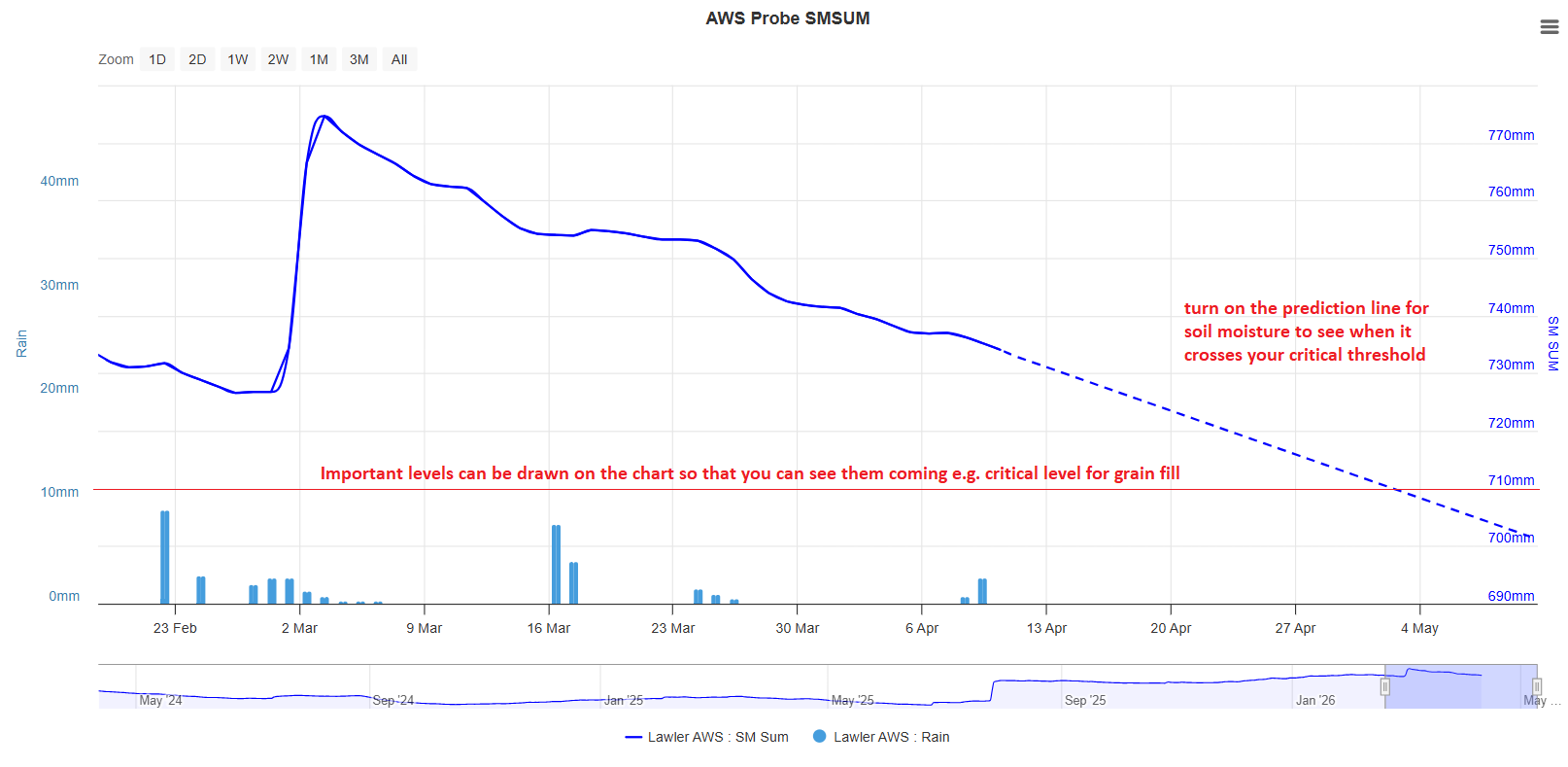
The idea is, if harvest is 60 days away, you need rainfall. If maturity is 30 days away, you might just get there. That awareness — simple as it is — is only possible if you have real-time soil moisture data..... unless you make a guess. Without it, you are estimating based on a spade and a feel for the paddock, which leaves a lot of uncertainty in a high-stakes decision.
Connecting Weather Station and Soil Moisture Data
The BushLinx® platform brings weather station data and soil moisture data together so you can see supply and demand in the one place, and understand where the crop is up to while you are looking at them trying to make a big decision. At the sharp end of a cropping season, that combined view is as good as it gets in using data to help make the right call.
A soil moisture probe tells you the supply side — what is in the profile and how fast it is being used. A weather station tells you the demand side — what the atmosphere is pulling out and what the crop is being asked to cope with. Neither is as powerful on its own at this end of the season. Together they let you weigh what water is left in the soil against how much more the crop needs to finish.
The other thing weather data brings to the table is timing. Crops do not develop on the calendar, they develop on accumulated heat, and how fast that heat accumulates depends entirely on the season your paddock has actually had. That is the difference between "wheat usually matures around this time" and a real estimate of how far off maturity your crop is. Once you have that, the question from the previous section stops being a guess and starts being more informed. Is there enough plant available water in the soil for 30 or 60 days? The answer to each might be different.
Know your run-home number before harvest
BushLinx® combines soil moisture and weather station data so you can track both the supply in your profile and the demand the weather is placing on your crop — in one platform.
See Soil Moisture Probes → Talk to Tim